
By Tayyab jajjvi | October 10, 2025
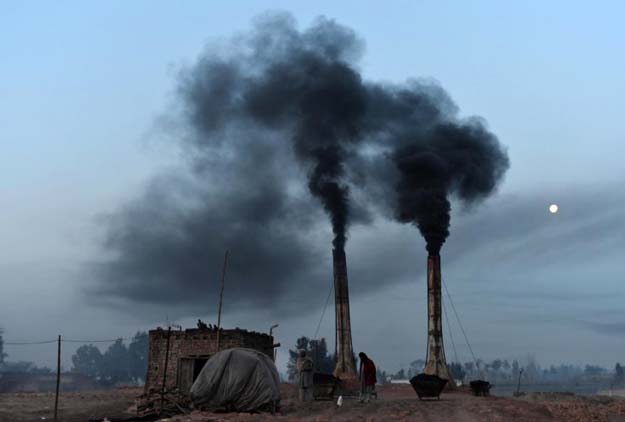
Pakistan stands at a dangerous intersection where rapid urbanization, poor governance, and global climate shifts are colliding to create a full-blown environmental crisis. From Karachi’s choking air to Sindh’s vanishing water, the country is in ecological freefall that threatens its economy, food security, and human survival.

Climate Change: A Global Threat with Local Disasters
According to the Global Climate Risk Index 2023 (Germanwatch), Pakistan is among the top 10 most climate-vulnerable countries in the world, despite contributing less than 1% to global emissions.
The 2022 floods, which submerged one-third of the nation and displaced over 33 million people, revealed the sheer scale of this threat.
In northern Pakistan, glaciers are melting faster than ever, according to the Pakistan Meteorological Department (2024) — causing dangerous Glacial Lake Outburst Floods (GLOFs). Meanwhile, the southern regions face prolonged droughts and saline intrusion from rising seas. Pakistan is now trapped between both extremes — too much water and too little.
Air Pollution: Breathing Becomes a Privilege
Pakistan’s largest cities — Karachi, Lahore, Faisalabad — are consistently among the world’s top 10 most polluted (Source: IQAir 2024 World Air Quality Report).
Smog has become a seasonal epidemic, forcing school closures and causing widespread respiratory illness. The WHO (2023) estimates 135,000 premature deaths annually in Pakistan from air pollution-related diseases.
Vehicular emissions, industrial discharge, garbage burning, and deforestation are the leading causes — yet the country still lacks a National Clean Air Policy with enforceable standards.
Water Scarcity: When the Taps Run Dry
Pakistan’s water availability has fallen from 5,600 cubic meters per person in 1947 to under 900 cubic meters in 2024 (PCRWR Report).
Over-extraction of groundwater, climate-driven droughts, and mismanagement of irrigation systems have pushed the country into a severe water crisis.
In Sindh, groundwater is turning saline, while Karachi’s residents rely on illegal hydrants for daily use. The World Bank (2024) warns that water scarcity could trigger migration, unemployment, and social unrest in the coming decade.
Heatwaves and Urban Mismanagement
In May 2024, Jacobabad hit 52°C, making it one of the hottest cities on Earth. The Pakistan Meteorological Department attributes this to deforestation and urban “heat islands” caused by excessive concrete, steel, and lack of green cover.
Cities like Karachi suffer from poor planning, plastic burning, and the absence of urban forests. As temperatures rise, so do energy demands, health emergencies, and mortality rates.
Agriculture: The Collapsing Backbone
Agriculture provides livelihoods for 40% of Pakistan’s population — but it’s collapsing under climate pressure. Erratic monsoons and groundwater depletion are cutting yields and threatening food security.
A World Bank Climate Report (2024) estimates that unchecked environmental degradation could cost Pakistan up to 9% of GDP annually by 2050. That’s not just a climate issue — it’s an economic emergency.
Policy Gaps and The Way Forward
Despite policies like the Ten Billion Tree Tsunami and the National Climate Change Policy 2021, Pakistan’s environmental response remains fragmented and weakly enforced.
To reverse course, Pakistan must:
- Establish independent environmental tribunals for accountability.
- Reform urban planning to include green spaces and sustainable transport.
- Modernize water management and pricing systems.
- Expand renewable energy projects in Sindh and Balochistan.
- Launch community education programs to shift behavior toward sustainability.
The Time to Act Was Yesterday
Pakistan’s environmental collapse isn’t inevitable — but time is running out. Climate change, pollution, and resource depletion are converging into a national security threat.
Environmental protection must no longer be treated as a secondary issue; it’s central to Pakistan’s survival. The future will belong to nations that protect their people by protecting their planet.
The writer is a journalist. He tweets at @tayyabjajjvi and can be reached at: tayyabjajjvi@gmail.com
Originally published in www.futuresoch.pk
Sources of content
- Global Climate Risk Index 2023 – Germanwatch
- Pakistan Meteorological Department (2024) – pmdd.gov.pk
- IQAir World Air Quality Report 2024 – iqair.com
- WHO Air Quality Data 2023 – who.int
- PCRWR Water Report 2024 – pcrwr.gov.pk
- World Bank Climate and Development Report 2024 – worldbank.org