
The Nobel Committee recognized Machado for “her unwavering commitment to non-violent political reform and her courage in the face of persecution.”
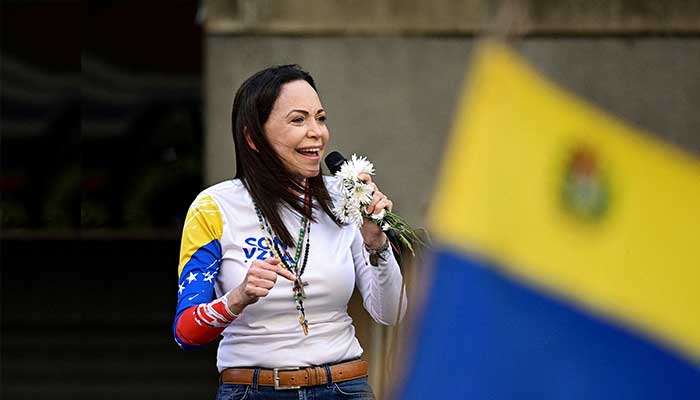
Venezuelan opposition leader Maria Corina Machado has been awarded the 2025 Nobel Peace Prize for her decades-long struggle to restore democracy, defend human rights, and promote political freedom in Venezuela — a nation suffering under years of authoritarian rule and economic crisis.
Who Is Maria Corina Machado?
Born on October 7, 1967, in Caracas, Maria Corina Machado is a 58-year-old industrial engineer and one of the most influential figures in Venezuela’s pro-democracy movement.
Coming from an upper-class family with deep ties to Venezuela’s industrial sector, she co-founded Súmate, a civil organization promoting electoral transparency. Over the years, she became one of the fiercest critics of the late Hugo Chávez and his successor, President Nicolás Maduro.
Her liberal economic stance — advocating privatization of state enterprises like PDVSA, along with strong social welfare for the poor — made her both a popular and polarizing figure.
Political Persecution and Defiance
Machado’s political journey has been marked by constant threats, arrests, and political bans. In 2023, she won Venezuela’s opposition primary with overwhelming support and was widely seen as the leading challenger to Maduro in the 2024 presidential elections.
However, the government banned her from holding public office, effectively blocking her candidacy. Despite the ban, her campaign inspired mass rallies and renewed hope among opposition supporters.
Facing repeated harassment, Machado went into hiding for safety. She briefly resurfaced to join a protest before Maduro’s controversial inauguration, where she was arrested and later released after international condemnation.
Her Message: “Our Struggle Is Collective”
In her Nobel acceptance message, Machado said the award “belongs to every Venezuelan who refuses to surrender their dignity.”
She emphasized that her mission is to “rebuild democratic institutions, restore economic freedom, and give voice to millions silenced by fear.”
Her campaign slogan — “Vamos con todo” (We go all in) — has become a rallying cry for citizens demanding change.
Global Reactions
World leaders, human rights organizations, and activists worldwide have praised the Nobel Committee’s decision.
- European Union officials hailed Machado as “a symbol of democratic resistance in Latin America.”
- Human Rights Watch said the award highlights “the urgent need for global solidarity with Venezuela’s political prisoners.”
- In Latin America, opposition leaders from Brazil, Colombia, and Argentina celebrated her recognition as a victory for all who fight against authoritarianism.
Meanwhile, the Venezuelan government condemned the award, calling it “a political interference by Western powers.” State media described the decision as “an insult to the sovereignty of Venezuela.”
Why It Matters
Machado’s Nobel win is more than a personal triumph — it’s a political statement that puts Venezuela’s human rights situation back in the global spotlight.
Over the past decade, millions of Venezuelans have fled economic collapse, hyperinflation, and repression. International observers see Machado’s recognition as a turning point that may pressure the Maduro government to open dialogue and allow free elections.
Venezuela’s Human Rights Context
- Over 7 million Venezuelans have fled the country since 2015 (UNHCR).
- Inflation peaked at 400% in 2024, according to IMF estimates.
- The UN Human Rights Office has reported hundreds of cases of arbitrary detention and torture linked to political dissent.
- The International Criminal Court (ICC) is investigating alleged crimes against humanity committed by Venezuelan authorities.
A Nobel That Rekindles Hope
Maria Corina Machado’s Nobel Peace Prize marks a rare global acknowledgment of Latin America’s democratic struggles.
For many Venezuelans, it revives faith that their decades-long fight for freedom is not forgotten.