BREAKING NEWS
Advertise with us >

Autonomous Robo-car now available for public purchase

Autonomous Robo-car

Self-driving vehicles are currently limited to a few countries and mainly offered through ride-sharing services. However, those who wish to own a car capable of autonomous driving—with minimal steering involvement—may soon have that option.

At the Consumer Electronics Show (CES) in Las Vegas, the company Tenser unveiled its new self-driving robo car designed for everyday consumers.

According to the company, the car can be driven manually as well. When seated in the driver’s position, a touch-screen display allows the steering wheel, brake pedals, and other controls to appear at the push of a button. In autonomous mode, the steering wheel is concealed inside a side screen on the driver’s seat.

The vehicle is equipped with dozens of microphones that enable passengers to give voice commands, such as adjusting the air conditioning or rolling down windows. Each passenger will have access to their own screen, with a total of four displays inside the car. Cameras mounted above each display also provide video call functionality. Passengers in the driver’s seat can interact with these features even while the car is in autonomous mode.

For safety and navigation, the car includes cameras, LiDAR, radar, and ultrasonic sensors that detect objects and help plan the route. Small external displays are installed at each corner of the car to signal pedestrians when it is safe to cross the street.

The robo car will be available in silver and black. While the company has not yet disclosed the price, it confirmed that the vehicle will be released to consumers later this year, initially in the United States, Europe, and the United Arab Emirates.

BYD tops global sales in new energy vehicles

BYD sets

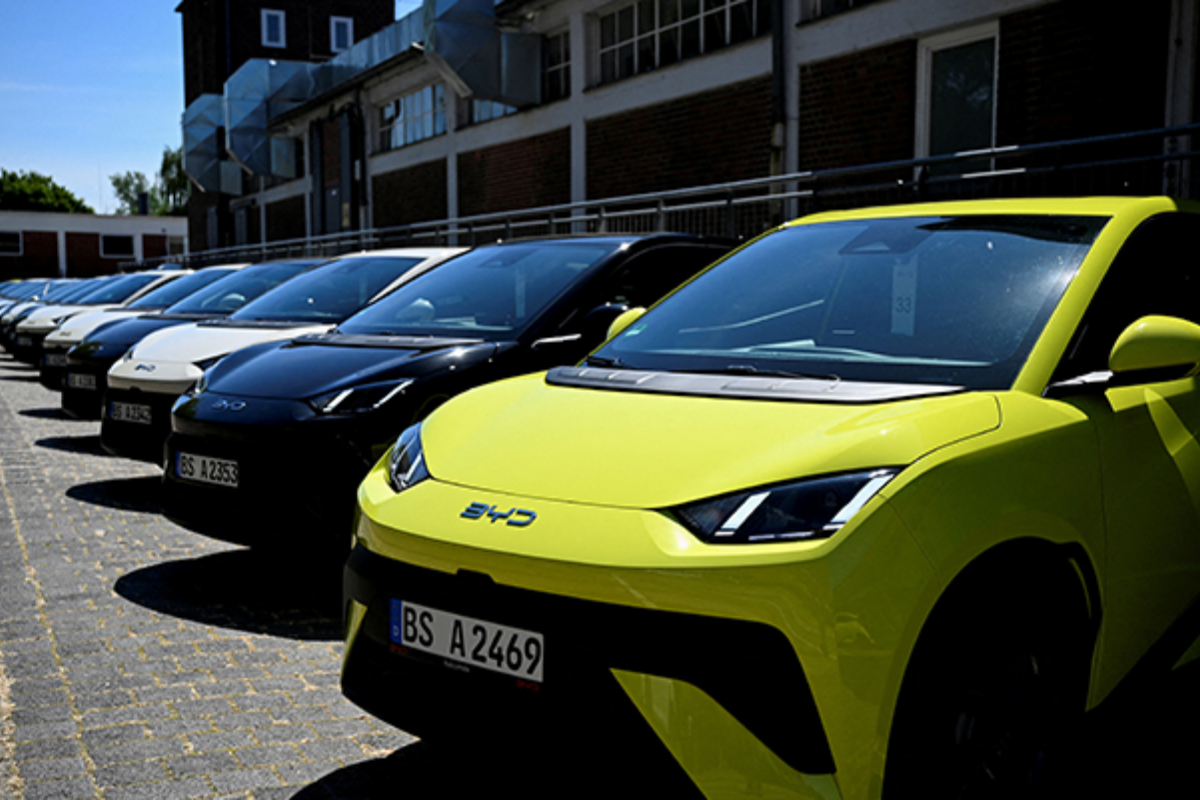
Chinese electric vehicle manufacturer BYD has announced its global sales results for 2025, reporting over 4.6 million new energy vehicles (NEVs) sold worldwide, securing its position as the top-selling NEV company globally.

For the first time, BYD achieved over 1 million overseas sales in a single year, marking a significant milestone in its international expansion.

Li Jian, Country Head of BYD Pakistan, stated, “The year 2025 has been a defining period for BYD. Alongside record-breaking sales, we have received remarkable recognition both domestically and internationally.”

He added, “In Pakistan, our vehicles have received overwhelmingly positive responses from consumers, reflecting the growing demand for new energy solutions.”

BYD sets new global EV sales record in 2025, overtakes Tesla

BYD sets

Chinese automaker BYD has set a new global record for electric vehicle (EV) sales in 2025, selling a total of 2.26 million units worldwide, the company said in a statement.

The milestone marks the highest annual EV sales ever achieved by a single manufacturer and places BYD ahead of US rival Tesla for the first time on a yearly basis.

Tesla had reported sales of 1.22 million electric vehicles by the end of September 2025, with its full-year results expected to be released on Friday.

According to a foreign news agency, BYD disclosed the sales figures in a statement submitted to the Hong Kong Stock Exchange.

The report noted that while BYD and other Chinese automakers face steep tariffs in the United States, the company’s sales continue to grow strongly across Southeast Asia, the Middle East and Europe.

It is worth noting that in 2024, Tesla narrowly outperformed BYD, selling 1.79 million electric vehicles during the year, compared to BYD’s 1.76 million units.

Pakistan considers overhaul of used vehicle import schemes

Pakistan considers

ISLAMABAD: The federal government has begun reviewing major changes to the used car import policy, including a proposal to abolish the Personal Baggage Scheme and impose stricter conditions on the Gift Scheme and Transfer of Residence Scheme.

According to official sources, the Ministry of Commerce has prepared a summary and forwarded it to the Economic Coordination Committee (ECC), recommending the complete withdrawal of the Personal Baggage Scheme.

The summary also suggests tightening regulations for the other two schemes to prevent misuse.

Senior government officials confirmed on Monday that several proposals are being examined, particularly measures to strengthen oversight of the Gift and Transfer of Residence schemes, while the Personal Baggage Scheme is likely to be discontinued.

The ECC will make the final decision on the proposed policy changes.

Abu Dhabi pioneers driverless car services in Middle East

Abu Dhabi

Abu Dhabi: The first successful flight of a domestically manufactured helicopter has been completed in Abu Dhabi.

The helicopter can carry up to 250 kilograms over a distance of 700 kilometers. The Abu Dhabi government announced that the aircraft will be used primarily for delivery purposes. Its advanced hybrid engine allows it to operate using both electricity and fuel, and the helicopter has been entirely manufactured in Abu Dhabi.

In addition, driverless vehicles are now operational in Abu Dhabi, with regular commercial services having officially started. This development makes Abu Dhabi the first city in the Middle East to operate autonomous vehicles commercially, with two Chinese companies providing the driverless cars.

PIMEC showcases blue economy potential as second day begins

PIMEC

KARACHI: The two-day Maritime Conference formally commenced as part of the ongoing Pakistan International Maritime Expo and Conference (PIMEC) at the Karachi Expo Centre. Global experts in maritime affairs are presenting research papers and sharing insights on the growth potential of the maritime sector.

According to organizers, a total of 176 exhibitors, including 28 international and 150 local companies, are showcasing their products and innovations at the event.

A two-day Maritime Conference has also begun as part of PIMEC, where global experts in maritime affairs will present research papers and discuss key developments in the sector.

Among the international participants, Iran’s pavilion has become a major attraction for visitors, while Türkiye has also set up its own display at the exhibition.

The primary objective of hosting PIMEC is to promote the Blue Economy and encourage growth in maritime trade and industry in Pakistan.

Federal Minister for Finance Muhammad Aurangzeb, addressing the conference via Zoom from Islamabad, congratulated the Pakistan Navy and the Ministry of Maritime Affairs for successfully organizing the international event.

Aurangzeb said it was encouraging to see the international maritime conference being held in Pakistan, adding that the Blue Economy could prove to be a game changer for the country’s economic future.

He acknowledged that Pakistan’s economy had temporarily weakened due to recent floods, but noted that “leading global financial institutions are now recognizing Pakistan’s improving economic trajectory.”

The finance minister emphasized that one of the key goals of the maritime conference was to attract foreign investment and highlight the potential of the Blue Economy in strengthening Pakistan’s economy.

“Through the Blue Economy, Pakistan can achieve its future economic targets,” he said, stressing the need to increase exports and ensure affordable energy for sustainable growth.

Aurangzeb assured participants that the government is committed to resolving policy-related challenges associated with the Blue Economy.

Highlighting Pakistan’s recent economic progress, he said that over the past two and a half years, the government has taken concrete steps toward stability, resulting in a sharp decline in inflation and a reduction in policy rates.

He added that three global credit rating agencies have commended Pakistan’s recent economic measures and that strong coordination among ministries is contributing to continued improvement.

Aurangzeb reaffirmed that the Finance Ministry would extend full cooperation to ensure economic stability, noting that Pakistan also enjoys support from friendly countries in promoting trade and investment.

The finance minister expressed confidence that the Blue Economy could revolutionize Pakistan’s economic landscape, pointing to the vast potential in fisheries and aquaculture. He also said that steps are being taken to modernize Karachi, Gwadar, and Port Qasim, further enhancing Pakistan’s maritime capabilities.

Vice Chief of Naval Staff, Vice Admiral Raja Rab Nawaz, visited various stalls at the exhibition and reviewed a range of modern naval and defense equipment on display.

During the visit, he was given a detailed briefing on Pakistan-made defense technologies and warfare systems, highlighting the country’s progress in indigenous defense production.