
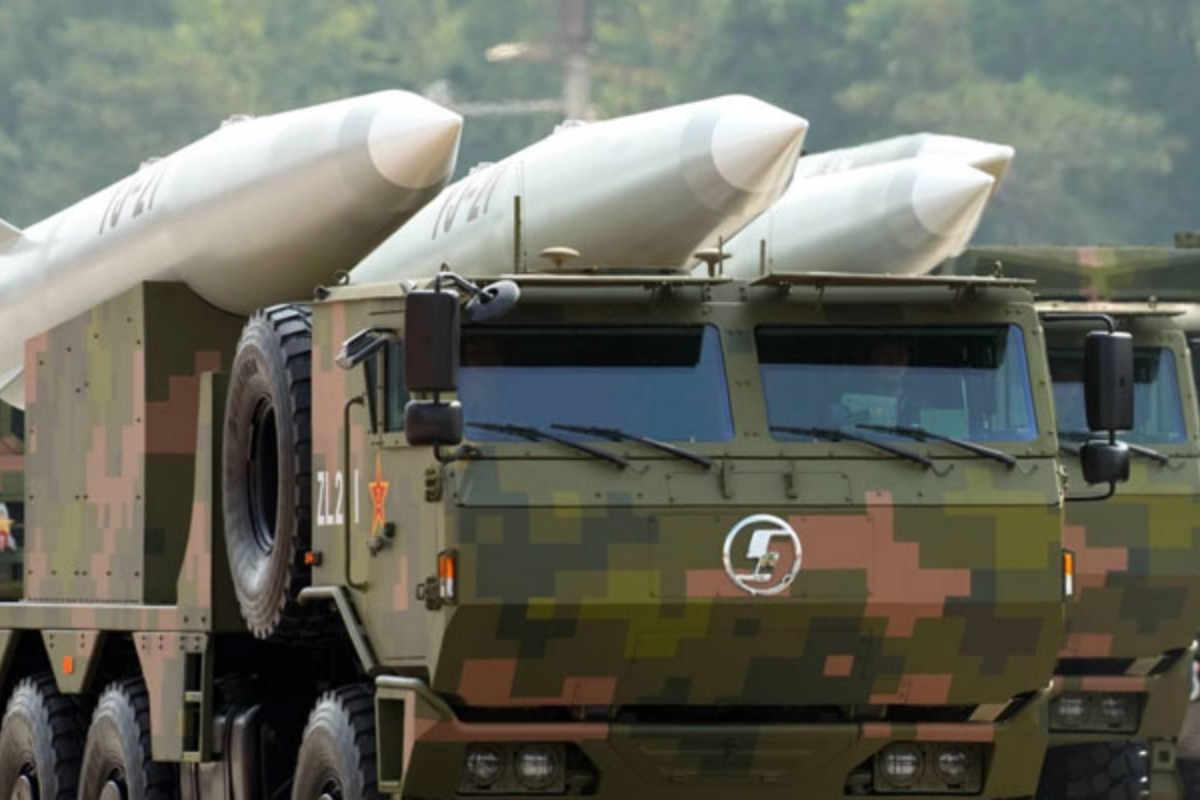
China has developed hypersonic glide vehicles capable of launching air-to-air attacks against aircraft thousands of kilometers away, potentially posing a major threat to U.S. command-and-control aircraft, aerial refueling tankers and other high-value assets, Bloomberg reported.
According to the report, people familiar with the matter said China has incorporated air-to-air attack capabilities into some hypersonic cruise missiles, while other variants have been designed to strike naval targets. Such weapons could allow China to disrupt communications and weaken the air-defense networks supporting fighter aircraft during a potential conflict.
A hypersonic glide vehicle launched by China’s DF-17 missile can travel about 2,414 kilometers, a range approaching the distance from China to the U.S. territory of Guam, which hosts a major American military base. China’s DF-27 missile is reported to have a maximum range of about 8,000 kilometers, potentially placing Hawaii within its reach.
Hypersonic glide vehicles can maneuver and change direction while traveling through the atmosphere, making them more difficult to track and intercept than conventional ballistic weapons. Bloomberg reported that China is currently the only country known to have combined hypersonic glide vehicle technology with air-to-air missile capabilities.
The development comes as China has significantly expanded its missile production. U.S. Defense Department estimates cited by Bloomberg indicate that China had at least 3,150 ballistic missiles and about 300 ground-launched cruise missiles as of 2024.
The report also comes as the United States works to develop longer-range air-to-air weapons. The U.S. Navy has been testing the AIM-424 MALD, a new long-range air-to-air missile reportedly capable of traveling more than 463 kilometers. The Pentagon has also been pursuing multistage air-to-air missile technologies with the longer-term goal of achieving ranges of up to 1,000 miles.