CALIFORNIA: Google has begun rolling out Gemini artificial intelligence features to its Chrome browser on Android devices, bringing several AI-powered tools to mobile users.
Google said in a blog post that the new features are initially being introduced to users in the United States. The tools were previously available on the desktop version of Chrome and are now being expanded to mobile devices.
The company said the new features are designed to turn Chrome into a more capable digital assistant, allowing users to interact with web content and perform a range of tasks directly through the browser.
One of the features allows Gemini to generate AI summaries of webpages and answer users’ questions about the content. Google is also integrating services including Gmail, Google Keep and Google Calendar into Chrome.
Another feature will give users direct access to Google’s Nano Banana image-generation tool within Chrome. Users will be able to create new artwork or turn text from webpages into images, as well as edit images.
Google is also introducing an Auto Browse feature, an AI agent designed to handle more complex tasks on the web. The feature, however, will be limited to subscribers of Google AI Pro and AI Ultra plans.
The rollout marks another step by Google to bring Gemini-powered tools into everyday mobile browsing and make Chrome more interactive and AI-driven.
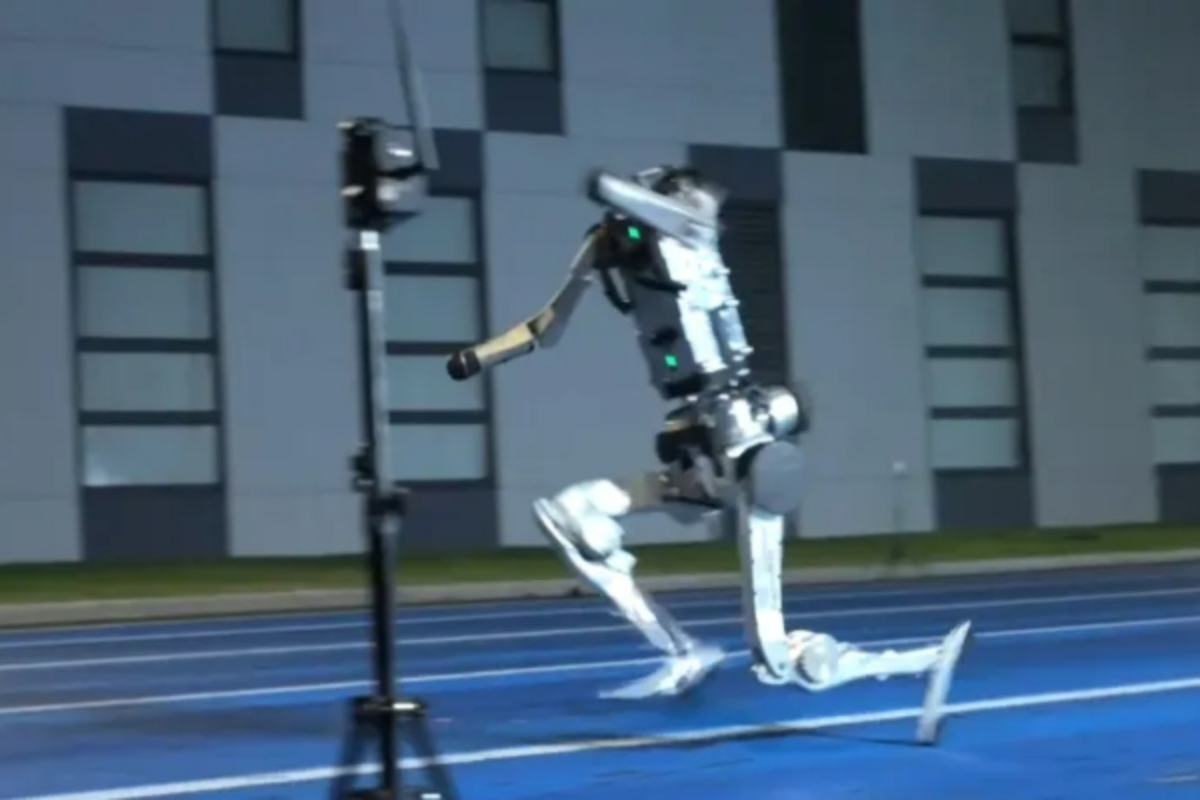
BEIJING: A Chinese robotics company has developed a humanoid robot that it says can run faster than Jamaican sprint legend Usain Bolt.
The robot, named Superman, was developed by Chinese robotics company Unitree Robotics and is equipped with artificial intelligence technology. A video of the robot was shared on X, showcasing its running capabilities.
According to the company, the robot was developed about three months ago and can jump up to 2 meters and run at a speed of 12.66 meters per second.
The claimed speed is faster than Bolt’s average speed during his world-record 100-meter sprint in 2009. Bolt completed the race in 9.58 seconds, equivalent to an average speed of about 10.44 meters per second.
The robot stands 5 feet 7 inches tall. Unitree said the machine demonstrates the potential to push beyond the physical limits associated with human performance.
However, the robot’s speed records have not yet been independently verified. Unitree said its performance could improve further in the coming months.
The robot is scheduled to be publicly unveiled on Aug. 19, when the company plans to offer its shares for sale. It will also be demonstrated during the World Robot Conference from Aug. 19 to 23.
Unitree’s robots won four gold medals at competitions last year, and the company is now expected to showcase further advances in humanoid robotics with Superman.
SAN FRANCISCO: Twenty-nine US states have taken Meta to court over allegations that the company designed Facebook and Instagram features in ways that encourage addictive use and could harm children and teenagers.
The trial began Tuesday in federal court in California and is expected to last six to eight weeks. Attorneys general from California, Colorado, New Jersey and Kentucky are leading the states’ legal team.
The states filed the lawsuit in October 2023, accusing Meta of violating federal and state laws by collecting data from children under 13 without parental consent.
States seek up to $200 billion in penalties
The 233-page complaint alleges that Meta knowingly declined to disable features that could be harmful to young users because of its focus on generating profits.
The states are seeking as much as $200 billion in penalties, an amount roughly equivalent to Meta’s annual revenue in 2025. They are also asking the court to require changes to the design of Meta’s platforms to make them safer for children.
State attorneys argue that Meta developed features intended to keep users spending more time on its platforms, with children and teenagers particularly vulnerable to their effects.
A jury is expected to hear testimony from Meta CEO Mark Zuckerberg, Instagram chief Adam Mosseri and former Meta employee Arturo Béjar, who has publicly raised concerns about the company’s practices.
Meta rejects allegations
Meta has rejected the allegations, arguing that the lawsuit is driven by the states’ efforts to obtain billions of dollars rather than by facts or applicable law.
The company said the allegations were unfounded and that the financial demands were inappropriate, adding that the states’ lawyers lacked sufficient evidence to support their claims.
The trial comes after a New Mexico court last week ordered Meta to pay $567 million in a separate case involving allegations that the company harmed children’s mental health and failed to adequately protect young users.
TORONTO: Artificial intelligence could cause widespread job losses and leave millions of people unemployed, according to computer scientist Geoffrey Hinton, widely regarded as one of the pioneers and “godfathers” of AI.
Hinton, a professor at the University of Toronto and winner of the 2024 Nobel Prize in Physics for work related to machine learning, has warned that companies could increasingly turn to AI systems to perform tasks currently handled by human workers at lower costs.
Speaking at Georgetown University, Hinton said companies were investing heavily in AI infrastructure, including data centers and computer chips, to accelerate automation. He said businesses would seek returns on those investments by developing and selling AI systems capable of replacing human labor.
Hinton said the pursuit of profits could ultimately encourage companies to replace employees with AI tools. Although AI would create new jobs, he said the number of positions created could be smaller than the number of jobs lost.
He acknowledged that predicting the long-term impact of AI is extremely difficult because no one knows what the technology will look like a decade from now.
Hinton has repeatedly warned about the potential dangers of advanced AI. He has previously estimated that there is a 10% to 20% chance that AI could eventually contribute to the extinction of humanity, while stressing that the risks need to be openly discussed.
He has also warned that AI systems could become more intelligent than humans within the next two decades. Hinton has described the prospect as frightening, comparing current AI development to a three-year-old child that could grow rapidly.
Hinton’s concerns come as other technology leaders make similarly significant predictions about AI and employment. Nvidia CEO Jensen Huang has said AI could affect almost every profession and shorten working hours, while Microsoft co-founder Bill Gates has suggested that humans could gradually become unnecessary for many tasks. Elon Musk has predicted that most people may not need to work within the next 20 years.
Hinton’s research helped establish the foundations of modern machine learning, enabling computers to perform tasks associated with human intelligence. However, he has become increasingly vocal about the need to make AI safer.
He left Google in 2023, saying he was concerned that the technology could be misused by malicious actors to harm people.
Hinton has compared the potential impact of AI with the Industrial Revolution. He said machines had already surpassed humans in physical strength, while AI could similarly begin replacing aspects of human intelligence.
Asked what life might look like in 10 or 20 years, Hinton said much would depend on how political systems respond to the technology.
He also acknowledged that AI could have major positive effects, particularly in medicine, and could improve productivity across almost every industry. However, he said the rapid development of the technology should be approached with greater caution.
WhatsApp is introducing a new artificial intelligence-powered feature designed to help users identify potentially fraudulent chats and protect themselves from scams.
According to a report, the scam detection feature will use on-device AI to flag suspicious conversations while maintaining the protection provided by end-to-end encryption.
The feature works by downloading a machine-learning model directly onto the user’s smartphone. The model analyzes messages from people whose phone numbers are not saved in the user’s contacts and assesses the language and pattern of the conversation for signs of potential fraud.
If a conversation is identified as potentially suspicious, WhatsApp will display a warning to the user. The warning will not be visible to the other person involved in the chat.
Users can then choose to block or report the sender, continue the conversation or mark the chat as trusted. Once a conversation is marked as trusted, WhatsApp will stop displaying scam alerts for that chat.
The company said the AI model has been trained to identify fraudulent activity.
Meta also said the feature would not compromise users’ privacy because the AI model operates on their devices and the company would not have access to their messages.
AI search is changing discovery, but Google’s official guidance says the foundation remains useful, original and technically accessible content.
Answer Engine Optimization, or AEO, is one of 2026’s fastest-rising digital marketing terms—but many of the promised “AI ranking hacks” are misleading. Google’s new guidance for generative AI search says established SEO fundamentals still apply to AI Overviews and AI Mode. There is no secret file, special schema or ideal article length that guarantees a citation.
What is Answer Engine Optimization?
AEO describes efforts to make content easy for search engines and AI-powered answer systems to discover, understand and cite. You may also see the term Generative Engine Optimization, or GEO. Google treats this work as part of SEO rather than a separate ranking system.
AI search systems can use retrieval-augmented generation to find fresh web pages and ground a response in sources. They may also use “query fan-out,” running several related searches to answer a complex question. That creates opportunities for pages that cover a useful subtopic well, even if they do not rank first for the user’s exact wording.
What actually improves visibility in AI search?
Publish non-commodity information. Original reporting, first-hand tests, local data and expert explanations offer more value than a generic summary.
Answer the main question early. Give readers a clear response, then explain evidence, limitations and next steps.
Use descriptive headings. Organise the page around the questions and decisions a real reader has.
Support claims with primary sources. Link directly to official data, research, filings or documentation.
Add relevant original visuals. Useful images, charts and video can help in multimodal search when they have descriptive context and alt text.
Keep the page crawlable and fast. Important content should load reliably on mobile and be accessible to search engines.
AEO myths Google says you can ignore
“You need an llms.txt file for Google.” Google says it does not use the file for generative AI visibility.
“Every paragraph must be a tiny chunk.” There is no required chunk size or perfect word count.
“Special AI schema guarantees citations.” No special structured data is required for AI Overviews or AI Mode.
“Create hundreds of keyword variations.” Scaled low-value pages can violate spam policies and waste crawl resources.
“Buy mentions to influence AI.” Inauthentic mentions are vulnerable to quality and spam systems.
A practical AEO checklist for publishers
Start with one high-intent query. Write a direct summary, add a comparison table or checklist where it helps, identify the source of every important number, include the publication and update date, and make the author and editorial responsibility clear. Add internal links to deeper coverage instead of repeating the same background in every story.
Then check technical basics: the page returns a successful status, is not blocked by robots rules, has a unique title and description, uses a canonical URL and renders the main text without requiring a user action. Structured data should match what readers can actually see.
How to measure AI search performance
Track organic clicks, engaged time, branded searches and conversions—not just reported “AI mentions.” Google’s guidance points website owners to Search Console, including its generative AI performance reporting where available. Compare pages by topic and intent, and update content when facts or product features change.
The bottom line
AEO is a useful label for a real change in search behaviour, but it is not a replacement for SEO. The durable strategy is to publish information that deserves to be cited: original, clear, well sourced, visually supported and easy for both people and search systems to access.
AI assistants differ in research, document, coding and productivity workflows; test them against the task you actually need to complete.
ChatGPT, Gemini and Claude can all write, summarize, analyze files and help with ideas, but the best choice depends on the job you need to finish. This practical 2026 guide compares them by task instead of declaring one universal winner.
The comparison is useful for students, freelancers, creators, small businesses and professionals worldwide. Product limits and features change frequently, so confirm availability on the official product page before paying for a plan.
Quick answer: which AI assistant fits which task?
Task
Good starting choice
Why
Mixed work with files, images and research
ChatGPT
A broad general-purpose workspace for analysis, writing, images and multi-step work.
Work connected to Google services
Gemini
Useful when your workflow already uses Google apps and services.
Long-form reading, careful drafting and coding
Claude
A strong option for structured writing, document work and developer workflows.
High-stakes facts or decisions
None on its own
Use primary sources and qualified professionals; AI can be confidently wrong.
What ChatGPT is best suited for
ChatGPT is a flexible starting point when one project involves several formats. OpenAI’s official capabilities overview describes support for working with images, uploaded content and generated visuals, while current plans may also include search, research and other tools.
Use it for: brainstorming, explaining difficult topics, reviewing files, drafting, data analysis, image tasks and multi-step work.
Practical advantage: you can keep related instructions and material together for a project.
Watch for: features and usage limits differ by plan, and generated citations still need to be opened and checked.
What Gemini is best suited for
Gemini is especially relevant when your daily work already lives in Google’s ecosystem. Google’s official Gemini overview highlights brainstorming, research, live interaction, image features and connections across Google products. Exact integrations depend on account, plan, language and region.
Use it for: idea development, summaries, planning, Google-centered workflows and conversations that benefit from screen, camera or live interaction where available.
Practical advantage: it can reduce switching between tools for people already using Google services.
Watch for: connected-app access should be reviewed carefully so you understand what information the assistant can use.
What Claude is best suited for
Claude is worth testing for careful long-form work, structured drafting and coding tasks. Anthropic’s official model documentation says its current models support text and image input, multilingual use and vision, although the available model and limits depend on the product and plan.
Use it for: revising long documents, comparing arguments, producing structured drafts, interpreting visual material and software-development work.
Practical advantage: its writing and document workflows can feel focused when the task needs sustained context.
Watch for: a polished answer is not proof that every claim, quotation or source is correct.
A better way to choose: run the same five-minute test
Marketing pages cannot tell you which assistant fits your own work. Test each available free version with the same non-sensitive task:
Write one clear prompt describing the audience, goal, format and constraints.
Give every assistant the same source material.
Ask for a first answer, then one revision based on feedback.
Check factual accuracy against the original sources.
Compare how much editing was required before the result became useful.
The winner is the tool that produces a reliable result with the least correction for your recurring task—not the one that writes the most impressive first paragraph.
Which assistant should students use?
Students should use AI as a tutor and reviewer, not as a replacement for learning. Ask for explanations at different difficulty levels, practice questions, feedback on your own draft or a study plan based on the official syllabus. Do not submit generated work as your own, and follow your school or university’s policy.
Which assistant should freelancers and small businesses use?
Start with the tool that matches your main workflow. A creator may value visual and research tools; a developer may prioritize code assistance; a consultant may care more about document review. Before buying a subscription, calculate whether it saves enough verified working time each month to justify the cost.
Privacy and accuracy rules that apply to all three
Do not upload passwords, identity documents, unpublished client files, medical records or confidential business information unless your organization has approved the service and settings.
Remove personal data from examples whenever possible.
Open cited links and verify that they support the claim.
Check calculations, legal claims, health guidance and financial information with authoritative sources.
Keep a human responsible for the final decision and published work.
Final verdict
Choose ChatGPT when you want a broad, multi-format work assistant. Choose Gemini when Google-centered integration is the main advantage. Choose Claude when long-form drafting, document reasoning or coding is your priority. For important work, keep at least one alternative available and judge tools by verified output rather than brand loyalty.
Future Soch independently prepared this comparison from official product information checked on August 13, 2026. Features, limits and availability can change. This article is not sponsored by OpenAI, Google or Anthropic.